Friday, 29 June 2012

Wholesome

A fellow home educator in an email, once described home ed as a 'more wholesome' method of learning than school. I've been really contemplating this lately and I thought I'd write down some of my thoughts.

Wholesome is defined in the Free Dictionary as:

whole·some (hlsm)
adj. whole·som·er, whole·som·est
1. Conducive to sound health or well-being; salutary: simple, wholesome food; a wholesome climate.
2. Promoting mental, moral, or social health: wholesome entertainment.
3. Sound; healthy. See Synonyms at healthy.
 
I immediately think of wholesome food. We're advised to eat heathy, wholesome foods in order to be healthy. Eating well helps us to perform better, live longer and be happier.
 
In The Family, A Proclamation to the World the Prophet tells us:
 
"Successful marriages and families are established and maintained on principles of faith, prayer, repentance, forgiveness, respect, love, compassion, work, and wholesome recreational activities."
 
What are wholesome recreational activities? I guess it's the same as food. They're activities which help us perform better, live longer and be happier. Activities which bring us closer as families, help us to relax, don't detract from the life we want to live. Watching good movies, playing sports, carrying out acts of service to name but a few.
 
So, how does this relate to education? A wholesome education should be one that helps us to perform better, live longer and be happier.
 
I want to help my children live wholesome lives and have a wholesome education.
 
I want them to experience as much of life as they can.
 
I want them to differentiate between what I believe is right and wrong.
 
I want them to be able to perform both in their personal lives and also in their future working and family lives.
 
I want them to live long and happy lives.
 
I want them to be children for a long as possible without fear of failure due to standardised testing, bullying, red pen marking and time restraints.
 
I want them to have access to clean toilets and helthy food when they need it.
 
I want them to have so many opportunities for learning that we can't get them all onto the calendar.
 
If I can achieve these aims for them and more importantly WITH them, then I will feel satisfied that I have provided them not only with a wholesome education, but a wholesome childhood.
 

Wimbledon and the physics of a tennis ball

Yesterday we were watching a bit of Wimbledon together and we got to talking about how tennis balls work. I've never really spent much time considering it to be honest but that's the beauty of home ed.

So today, we put a tennis ball in the fridge for a few hours and then dropped it alongside a room temperature ball to see what would happen. (I won't tell you if you don't know)

Then we pretended to be molecles. First of all they were molecules in a solid. They all stood rigidly together so that I couldn't move one without the other. Then they were molecules in water. When I 'poured' them into a square pot, they took the shape of the pot. Then we all became gas molecules. I was running round like a mad thing and suddenly caught sight of George 1 looking at me in utter disbelief and he said "you've gone hyperactive!" I was just very happy that he'd understood the concept.

I then acted as if I was a molecule in the gas inside a tennis ball, and showed them how a tennis ball bounces. They thought it was hysterical.

They then wanted to put a tennis ball in the freezer too and when we got back from a firebuilding activity at the City Farm, they immediately got their tennis balls out to carry on the experiment. I think they felt sorry for the frozen gas molecules all hunched up and lacking energy!

All in all, it's been a perfect home ed day and has got me over my little wobble that I had earlier on in the week.

Tuesday, 26 June 2012

A few thoughts on monitoring

One of the questions that I am frequently asks by friends and others that I meet, relates to monitoring and testing and the National Curriculum. Once again, like other questions that I have attempted to answer, it;s a valid thought and requires time in answering. Although I may be asked it daily, to the enquirer, it's what education is ultimately about. When children are in school they are constantly monitored, they are tested, reports are sent home to parents, OFTED inspectors make sure that schools are performing, there are league tables and results that help parents to choose a school. The national curriculum has been designed to enable children in school to learn a variety of subjects. It's by no means an exhaustive list of things to learn, but it provides a base line for education. This is what the majority of people consider education to be, a list of subjects set out that all children need to know about. Of course, later on those subject become exams which are viewed as necessary for future life by employers and further education establishments.

So, the simple answer to the question is: NO. We are not monitored or OFSTED inspected and we don't need to follow the National Curriculum.

The law as laid out in the Education Act 2006 states:


“The parent of every child of compulsory school age shall cause him to receive efficient
full-time education suitable –
(a) to his age, ability and aptitude, and

(b) to any special educational needs he may have,

either by regular attendance at school or otherwise.”

If you wish to read the guidelines you can do so here Elective Home Education Guidlines for Local Authorities

The guidelines go on to explain to the local authority what their duties are in relation to home educating families.

2.7 Local authorities have no statutory duties in relation to monitoring the quality of home
education on a routine basis.

This is very clear instruction. It does go on to say however, that the LA can intervene if it comes to their attention that a child is not receiving suitable education, however, it is not their role to monitor. Yet, many many home educators are hounded by their local authorites. Visits are requested, work is asked to be seen, some even ask to speak with the children. No one goes into school to speak with the children from the LA. It is a teachers role to check on progress and welfare of the child. At home, it is the parents role and reponsibility.


Just to clarify, parents of home educated children are NOT required to:
teach the National Curriculum

provide a broad and balanced education

have a timetable

have premises equipped to any particular standard

set hours during which education will take place

have any specific qualifications

make detailed plans in advance

observe school hours, days or terms

give formal lessons

mark work done by their child

formally assess progress or set development objectives

reproduce school type peer group socialisation
match school-based, age-specific standards.

So, what can the LA do to find out of an education is taking place? The LA has the right to make informal enquiries relating to the educational provision in the home. The parent is advised to have contact with the LA, however, this does not need to include a visit.

Some parents may welcome the opportunity to discuss the provision that they are making
for the child’s education during a home visit but parents are not legally required to give
the local authority access to their home. They may choose to meet a local authority
representative at a mutually convenient and neutral location instead, with or without the
child being present, or choose not to meet at all. Where a parent elects not to allow access
to their home or their child, this does not of itself constitute a ground for concern about the
education provision being made. Where local authorities are not able to visit homes, they
should, in the vast majority of cases, be able to discuss and evaluate the parents’ educational
provision by alternative means. If they choose not to meet, parents may be asked to provide
evidence that they are providing a suitable education. If a local authority asks parents for
information they are under no duty to comply although it would be sensible for them to do
so.
Parents might prefer, for example, to write a report, provide samples of work, have their
educational provision endorsed by a third party (such as an independent home tutor) or
provide evidence in some other appropriate form.

A letter from a parent should, in most cases be enough to satisfy that education is being provided.

I hope that this has helped to answe some of the questions that many of my non home educator readers may have regarding monitiring and the national curriculum.


P.S. A word about safeguarding

Lots of people share a concern that home education is a way of concealing abuse. There is evidence that suggests that there is no more abuse amongst home educators than amongst schooled children. In fact, there is likely to be less. Even if the LA was entitled to monitor on an annual basis, it would be unlikely that any abuse would be picked up. Protection from children at risk is of course extremely important, however, home education should NEVER be viewed as abuse. I personally feel that denying a child the right to an education is a form of abuse, but again, it is not the primary issue with regards to monitoring. Safeguarding is a separate and important issue and one that the majority of home educators find very difficult as the finger is easily pointed.


Swindon Recycling Centre trip

Last week we had the privilege of visiting the Swindon Recycling centre. It was a fascinating visit and really highlighted how important it is to recycle. Here is a picture of George 2 standing by a can mountain.

This is just one weeks worth of cans from the 52% of people who recycle in Swindon! Thats's a lot of cans, but still that number again go to landfill.

Once they've been crushed they're put into cubes like these and transported to a place where they're made into new cans.


I'm grateful to people for organising trips like this. It's another example of the opportunities available to home educated children

Wednesday, 6 June 2012

Olympic fever

We've started our Olympics project now. As we learn, we're going to decorate a table cloth. It's a lot more exciting than worksheets that's for sure. The Olympic rings were fun to do, making sure that they all linked the right way. Then George 1 designed his own torch with George 2 drawing the flame.

At his knitting group today, George 2 (who you must remember is just 5) made a scarf with coloured pompons on the ends. He chose the olympic flag colours for his pompoms.

The picture of Georgiana is just because she's so drop dead gorgeous!

Sunday, 20 May 2012

Why do we home educate?

This is a question that I am asked almost daily. I'm asked it by friends and family, by people in shops and most often by other home educators. I ask them as well of course, the story of how we come to home educate is almost as compelling as a good old birthing story. It's one which, as we tell it, helps to cleanse and focus our minds on the true wonder of what we have achieved.

Unlike a birthing story, which stays the same each time we tell it, the reasons for home educating change with the seasons, and sometimes just with the passing of hours.

In order to fully answer this question, I need to go back to the beginning of my home ed journey. Right back almost 4 years to when George 1 was preparing to start reception class. I had heard of home ed then, I had friends who do it, but we had found a good school and I felt at the time that that's what was 'supposed' to happen. My little 4 years and 2 week old baby was going to school, because that's what you do. He very much enjoyed reception. He had lovely teachers who nurtured and played and taught. It was a relaxed atmosphere and yet somehow I lost my baby. He disappeared and became someone else's child. I didn't know what he was doing. The 10ft high green metal fencing created a physical, emotional and spiritual barrier between us. For 3 years, i listened to those gates shutting behind me, locking him in and me out. Each afternoon I picked up an ever increasingly grumpy and distant stranger. Occasionally I'd get a little insight into his day. A little snippet of information.

Then mid-way through year 2 the unhappiness in him began to show. He also felt alienated from our family. Separated off from the achievements at home. He felt stifled by school. A lot of the things that were being taught didn't make sense to him and he struggled with simple tasks. He's not stupid, in fact quite the opposite, but he doesn't learn well in formal teaching environments. He's not particularly speedy. He's a great thinker and philosopher and so recalling facts quickly was difficult for him. Its expected a lot in school.

Then came the refusal, hiding under the table in the mornings and crying. Being so stressed and exhausted in the evenings that he couldn't even eat. He looked terrible. Huge black circles under his eyes on top of extremely pale skin.

So it led me to thinking about alternatives. During the summer holiday last year, we brought it up with him. The change in him was instant. A little light shone in his tired eyes. The realisation that there was an option other than school. The life started to return. His last day at school was probably the greatest of his life so far. I've never seen such an excited and happy child. A thousand horses couldn't have held him back from running out of the gates that day.

That's what led me to home ed in the first place. Many say I'm over protective, that children should face unhappiness to become stronger. Some say that bullying even is a necessary part of character building. I want to pt it on record now that I DO NOT AGREE! Just as a child doesn't need to smoke in order to know it's not good, a child doesn't need to be faced with bad language, bullies, sexual images and behaviour or negative adult attitudes, to know that they're wrong. I'm not saying that my children came across these things early on in school, but they will eventually, and yes, I do want to protect them from it as long as I can.

Another of my reasons to continue with home ed now we've started is simply to do with EDUCATION.

I have learned more about what education is and what it entails in the past 6 months that I have in the previous 30 years of my own formal educational life. Ive said it before and I'll say it again, I ADMIRE TEACHERS (mostly). They work hard and do an amazing job. They show genuine concern for children's well being, although they are so busy that mostly, its only serious problems that can be dealt with. They teach with skill and patience and dedication. They have to be dedicated to get the job done.

That leads into my final reason for today. The privilege of being able to witness my children learning and knowing exactly what they're learning. To witness a child learn to read, grasp a maths equation that has previously been a mystery, ASK to look at a specific period in history having done anything before to avoid the word history, actually enjoy reading poetry and not be able to pt a book down because there's no time restraint, play so freely because that's what they are - free - is the greatest privilege I could ever ask of as a mother. I am possibly the luckiest mummy in the world!

I'll say this again too, home ed is not the perfect solution. Not always. For most people, school is a good and valid option for their children. For me and my family, right now, school is not where we are supposed to be.

Saturday, 19 May 2012

Some things we've been up to

It has been so long since I last wrote that I cannot possibly begin to remember what we've been doing. The boys have really begun getting into this learning thing now and they have been really enjoying themselves with little projects

 
George 1 has been doing a pile of maths from long subtraction to decimals and minus numbers. He's taught himself largely by trying things out and asking us for help. It's been wonderful to be a part of such a huge learning curve. When he came out of school, even the slightest mention of the word learning sent him hiding under the table. Now he comes to me with topics he'd like to know more about.

 
George 2 has been continuing with Reading Eggs He is really doing well and is starting to sight read some of the common words. It is such a huge privilege to be a part of this early development. He's also busy learning to tell the time and doing fractions.

George 3, although only 2yrs old, absolutely adores sitting at the table and writing. His mark making is fabulous and he recognises his initial letter everywhere now.

Georgiana is growing and growing, quietly sitting on my knee just soaking up all the love.

So, I've decided to just use photos to show what we've been doing again. A picture speaks a thousand words anyway!


We melted wax crayons onto canvas in an art project. What amazed me was the we all did the exact same thing and yet they all came out so differently. I love them on the dining room wall.


On St George's day we read a story about St George then all 3 boys drew pictures. We then made the pictures into our own story.


George 2 decided to write a wordsearch for DadaSmu based on some work he had done about the Atlantic Ocean. He hid 4 words and did the most beautiful lettering. DadaSmu found all the words and George2 really enjoyed writing it. The hot chocolate always seems to aid concentration somewhat!


Here's George 3 doing his writing

A bit of archery in the afternoons. DadaSmu found his bow and arrows in the shed and the boys had it confirmed that he is in fact the best Daddy in the world!


Here, I wrote out some sentence strips for George 2 to put with pictures of our family doing various things.

George 1 had the same pictures but lots of individual words so that he could make some more elaborate and/or funny sentences. This kept them amused for a surprisingly long time one very wet day.

They made some air dry clay models at our home ed group one day and then painted them at home. George 2 got a fair amount of paint on his head!


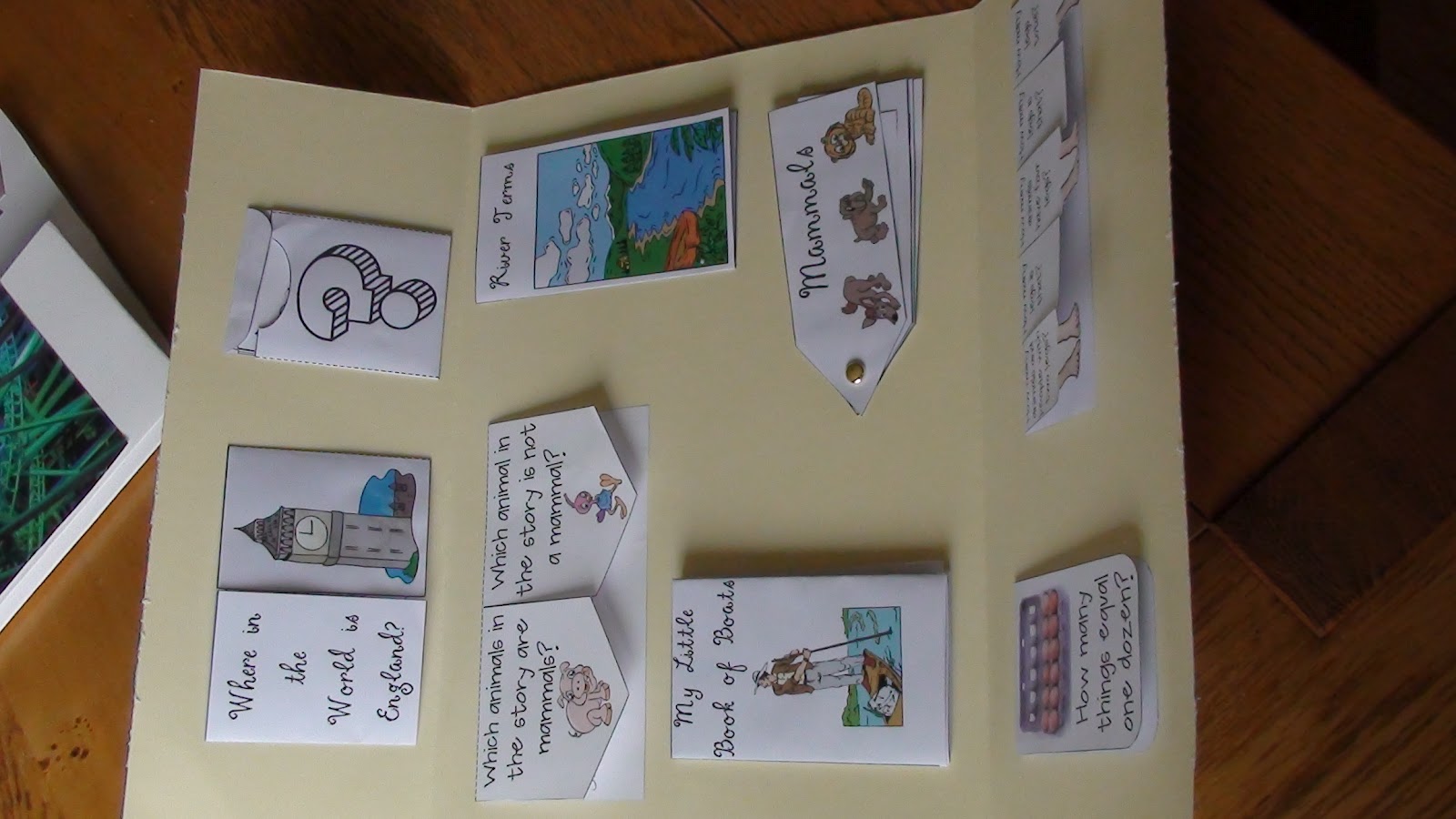
Here are some Lapbooks. George 2 has done the dinosaur and Mr Gumpy's outing ones. George 1 did a week long project about roller coasters.

The dinosaur study covered geography, adjectives, reptiles and making a graph showing the sizes of dinosaurs.

The project on roller coasters led to a study of Sir Isaac Newton, history, geography, graph making and lots of new word definitions

Mr Gumpy's Outing covered maths (addition and multiplication), geography (river terms), different types of boats and the definition of mammals


Lapbooks are a fabulous way of learning. The next one we do will be about the Olympics. 

Georgiana is just growing and looking pretty

  •